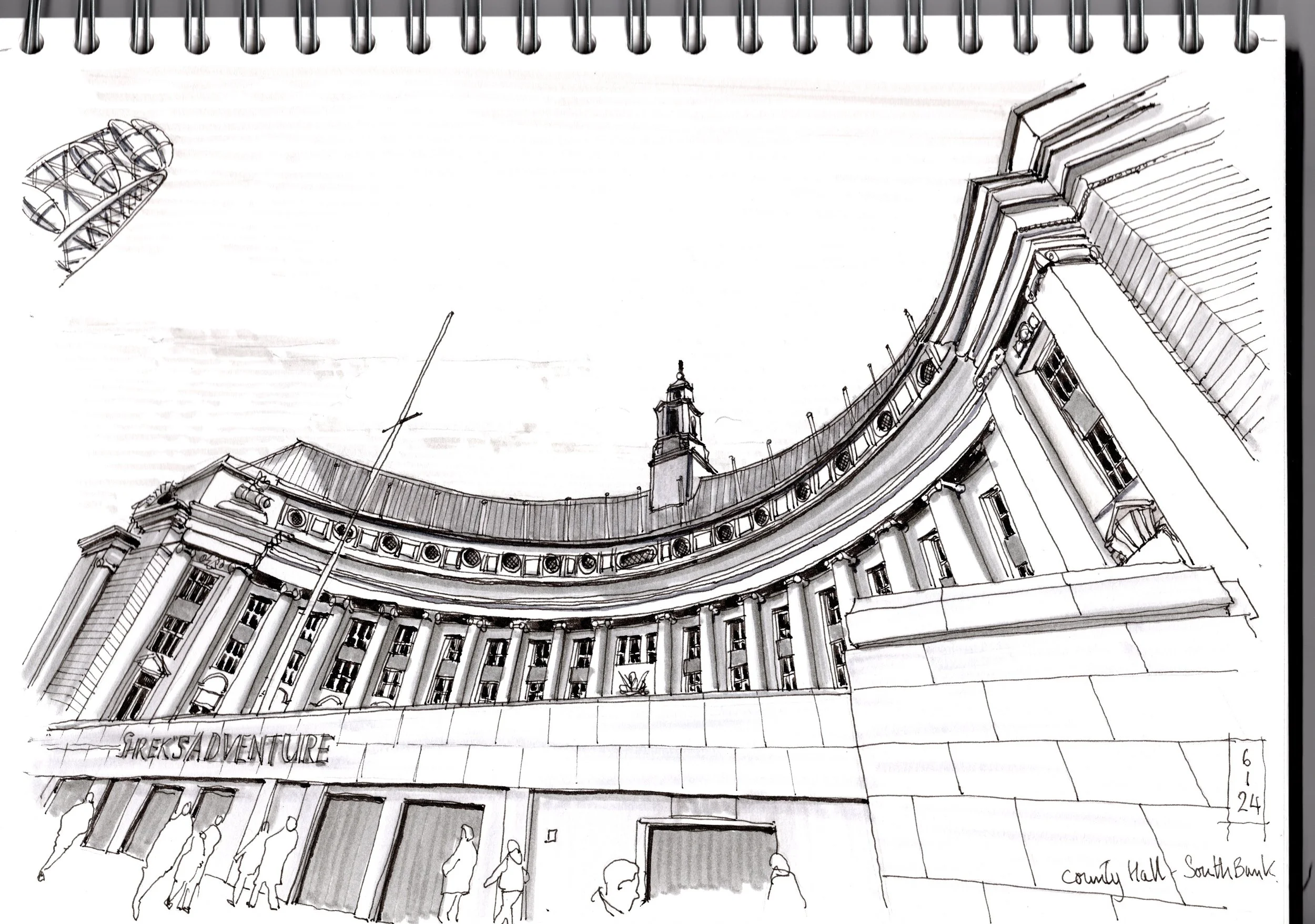
County Hall - Southbank
County Hall
Sitting on the South Bank of the Thames, County Hall was built to replace the Metropolitan Board of Works' headquarters at Spring Gardens. The chosen site had previously housed various properties, including Simmond's flour mills, Crosse & Blackwell's factory, and several wharves and houses, adding to its rich history.
The building, designed by Ralph Knott in an Edwardian Baroque style and faced with Portland stone, is grand and imposing. Construction began in 1911 and was handled by the builders Holland, Hannen & Cubitts, but World War I delayed progress. Eventually, in 1922, King George V officially opened County Hall. Over time, two more wings were added—North and South Blocks—between 1936 and 1939, courtesy of the construction firm Higgs and Hill. A more modern extension, the Island Block, wasn’t completed until 1974.
The Island Block was an architectural oddity compared to its neighbours. With no ground-level entrances (except emergency exits), it could only be accessed via a bridge and tunnel from County Hall's southeast wing. Its distinct feature was its orange sunshades, which were supposed to rise and fall automatically in unison, but technical issues led to a random, mismatched appearance that added to the building's unpopularity among locals. Yet some architects considered it a noteworthy example of early open-plan office design. Despite its critics, it stood until 2006, when it was demolished to make way for the Park Plaza Westminster Bridge hotel.
For 64 years, County Hall served as the beating heart of London’s local government, housing the London County Council (LCC) and the Greater London Council (GLC). In the 1980s, under Ken Livingstone's leadership, County Hall became a symbol of opposition to Margaret Thatcher's Conservative government. The building's façade was frequently adorned with protest banners that faced directly across the river to the Palace of Westminster, ensuring those in power saw them.
However, County Hall's political significance ended abruptly when Thatcher's government abolished the GLC in 1986. Afterwards, there were plans to repurpose the building, including a proposal to relocate the London School of Economics there, but these plans fell through. For a while, the Inner London Education Authority (ILEA) occupied the space until it too was disbanded in 1990. The building was transferred to the London Residuary Body before being sold to the Japanese investor Shirayama Shokusan.
The story didn’t end there. In 2005, County Hall made headlines when the High Court ruled in favour of Shirayama Shokusan, evicting the Saatchi Gallery due to a contractual breach. The gallery had allegedly used space outside of its rented area for exhibits. In the following years, parts of County Hall were redeveloped for other uses.
Today, County Hall is no longer the political powerhouse it once was, but it has found new life as a hub for leisure attractions. The building now houses Merlin Entertainments, whose attractions include the Sea Life London Aquarium, London Dungeon, Shrek's Adventure!, and the nearby London Eye, making the area a magnet for tourists.
The building’s grand old council chamber has also been given a new lease of life. Since October 2017, it has been home to a site-specific production of Agatha Christie's *Witness for the Prosecution*. This immersive experience allows audiences to relive the courtroom drama within the historic space, adding another layer of intrigue to County Hall's evolving story.
As for accommodations, County Hall is now home to two hotels. The Premier Inn London County Hall offers affordable lodging in the historic building, while the London Marriott Hotel County Hall provides a more luxurious option, with stunning views of the river and Westminster across the water.
A blue plaque commemorates the legacy of the LCC, GLC, and the ILEA at County Hall, marking its significance in London's civic history. From political battles to public attractions, County Hall remains a prominent feature of the South Bank, continuing to evolve while retaining its historic charm.